
Features
Everything a mock audit produces, in one place.
Upload your claim and the evidence behind it, and get simulated audit questions, evidence scoring, an AI cross-check and an evidence readiness score. Every feature below is built from the same answers and the same uploaded evidence.
Country check
Pick the country where the claim is made. creditARMOUR confirms the programme it falls under and the authority that reviews it, and builds the mock audit from that programme's own question set.
Six programmes are covered. A mock audit never borrows questions from another country's rules.
See the six programmesNEW MOCK AUDIT · PROGRAMME
Sample dataWhich programme do you claim under?
Programme
R&D Tax Relief (Merged Scheme and ERIS)
Question set
HMRC · 12 simulated questions
One programme per mock audit. Question sets are never mixed.
Upload your claim and evidence
Start from the claim as filed, or as you plan to file it: the technical narrative, the cost workings and the documents behind them.
Files are organised against the question set, so you can see which questions already have evidence and which have none before anything is scored.
What to prepareEVIDENCE UPLOAD · UK
Halden Robotics Ltd
- Payroll reports (P11 or payroll software exports) for each claimed individual
- Timesheets or time-tracking exports
- Design documents, test plans and test results with dates
- Signed subcontractor agreements and statements of work
- Claim workings by cost category with ledger references
Simulated audit questions
Twelve simulated questions for your programme, grouped by theme, in the order a review tends to ask them. Each one says what it is testing.
The questions are modelled on published guidance. They are a simulation, not the authority's questions, and nothing is sent to an authority.
How it worksAUDIT QUESTIONS · UK
Halden Robotics Ltd
- UK01Advance in science or technologyWhether the project sought an advance in the field, not only in the company's own knowledge or products.
- UK02Scientific or technological uncertaintyWhether the uncertainty is stated as something a competent professional could not readily resolve, and when it was resolved.
- UK03Competent professional identifiedWho judged the advance and the uncertainty, and what their qualifications and experience are.
- UK04Routine work excludedHow routine engineering, testing, commercial and administrative work was separated from the R&D activity.
- UK05Staff costs and time apportionmentHow staff costs were calculated and how the proportion of time on R&D was determined and recorded.
Evidence scoring
How each answer is matched to uploaded evidence and rated strong, needs work or red flag.
Every answer is rated strong, needs work or red flag, and the ratings roll up into one evidence readiness score out of 100.
Learn more about evidence scoringEVIDENCE SCORING · UK
Halden Robotics Ltd
- UK01Technical uncertainty describedStrong
Project narrative v3, sections 2 and 3
- UK03Staff time allocation recordsNeeds work
Payroll export, management estimate spreadsheet
- UK04Subcontracted R&D costsRed flag
Three invoices, no agreements
- UK09Consumables and software costsStrong
Purchase ledger extract, licence list with usage notes
AI cross-check
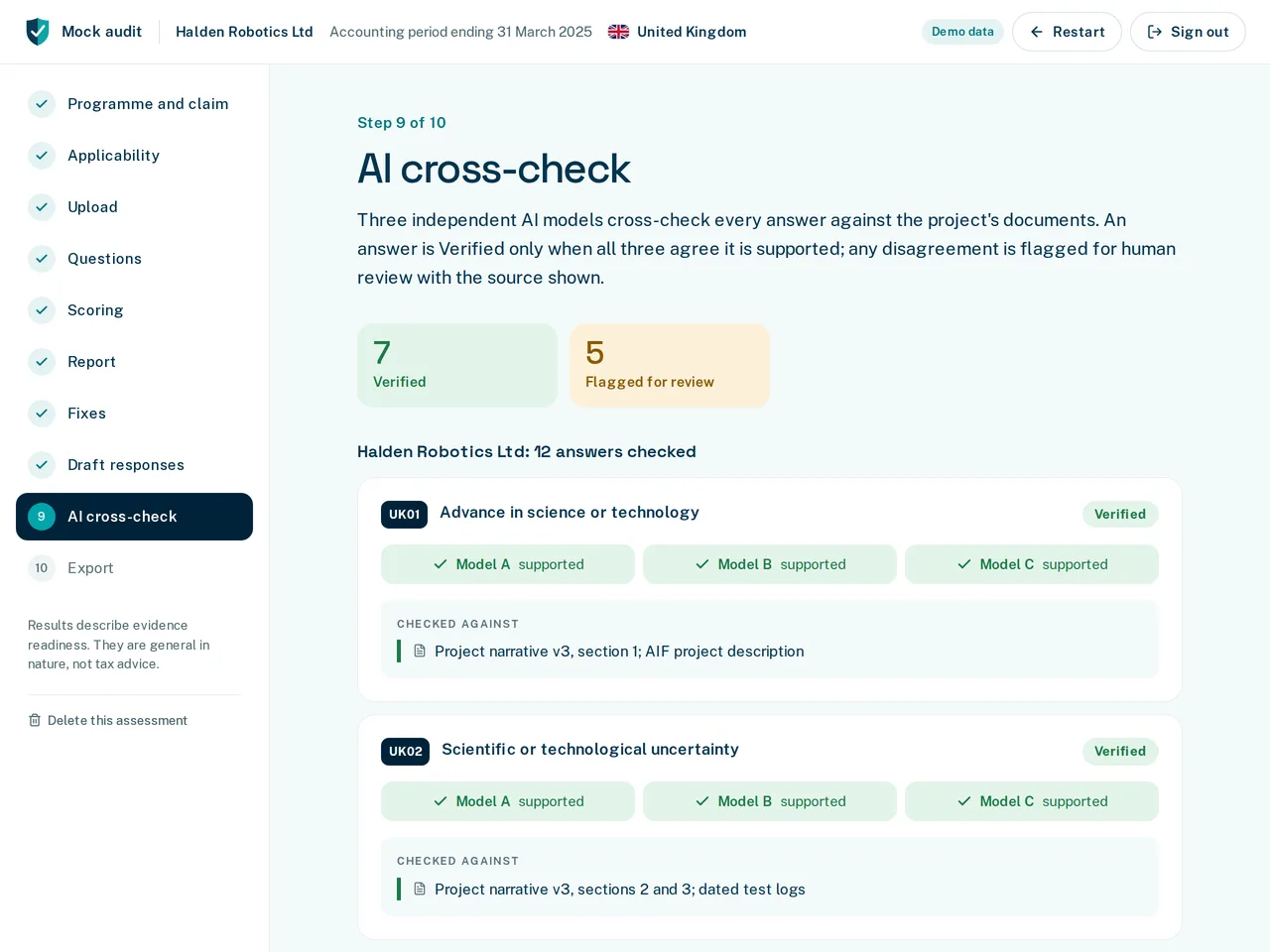
Three independent AI models cross-check every answer and evidence match against your supporting documents. An answer is marked Verified only when all three agree it is supported.
Any disagreement or unsupported statement is flagged for human review, with the source shown alongside it.
See it in a mock auditAI CROSS-CHECK · UK
Halden Robotics Ltd
7
Verified
5
Flagged for review
- UK01
“The project sought to resolve a stated technological uncertainty.”
VerifiedModel AModel BModel CUncertainty is stated as a question the team could not answer from existing knowledge.
Project narrative v3 · section 2
- UK05
“Every claimed cost line reconciles to the accounts.”
VerifiedModel AModel BModel CQualifying expenditure agrees to the trial balance and the CT600.
Claim workings · tab 1
- UK04
“Each subcontractor worked under a written agreement.”
ReviewModel AModel BModel CInvoices describe ‘engineering services’ only.
Subcontractor invoices · 3 files
Risk assessment
Ratings roll up into the evidence readiness score, with the count of strong answers, answers that need work and red flags beside it, so you can see where the file is weakest.
The score describes evidence readiness. It is not a probability of audit and not a decision by any authority.
Read the risk methodologyASSESSMENT · UK
Halden Robotics Ltd
HMRC · Merged RDEC- UK01Technical uncertainty describedStrong
- UK03Staff time allocation recordsNeeds work
- UK04Subcontracted R&D costsRed flag
- UK05Claim calculation reconcilesStrong
EVIDENCE READINESS
68/100
- Strong
- 7 of 12
- Need work
- 3 of 12
- Red flags
- 2 of 12
Red flags
Answers that are contradicted by evidence or missing it entirely, and why they are shown separately.
They are listed separately so they are dealt with first.
Learn more about red flagsRED FLAGS · UK
Halden Robotics Ltd
- UK04Subcontracted R&D costsRed flag
Invoices describe 'engineering services' only. No contracts or statements of work show that the work was R&D performed on the company's behalf.
- UK11Grant and subsidy treatmentRed flag
A grant covering part of the project is on file but the claim does not identify which costs were subsidised. This affects the scheme the costs fall under.
Fix plan
A prioritised list of actions with impact and effort ratings, linked to the questions they address.
Work through the fixes, add the missing documents and re-score to see what moved.
Learn more about fix planFIX PLAN · UK
Halden Robotics Ltd
- FX3Attach subcontractor agreementsImpactHighEffortLow
- FX7Rebuild time allocationImpactHighEffortMedium
- FX1Separate routine workImpactMediumEffortMedium
- FX12Record approval of final figuresImpactLowEffortLow
Draft responses
Editable draft answers written in the programme's language, which stay in your account until you choose to use them.
Each draft is marked as a draft for review. It is a starting point for you or your adviser, never a submission.
Learn more about draft responsesDRAFT RESPONSE · UK04
Halden Robotics Ltd
QUESTION
Which subcontractor costs are claimed, and what did each contractor do?
DRAFT
Risk report export
The summary report with the evidence readiness score, question-by-question results and the top fixes.
Export it as a PDF for your team, your board or your adviser. Every page carries the simulation disclaimer.
Learn more about risk report exportRISK REPORT · UK
Halden Robotics Ltd
EVIDENCE READINESS
68/100
- Strong
- 7
- Need work
- 3
- Red flags
- 2
Reviewed programme rules
Each country's question set, evidence checklist and guides are written from that programme's published guidance and revisited when the guidance changes.
Every country guide shows the date it was last reviewed, so you can see how current the reading of the rules is.
See assessment scopePROGRAMME RULES · LAST REVIEWED
6 programmes- AustraliaR&D Tax Incentive27 November 2026
- CanadaSR&ED Tax Incentive Program27 November 2026
- IrelandR&D Tax Credit27 November 2026
- New ZealandR&D Tax Incentive (RDTI)27 November 2026
- SingaporeR&D Tax Deductions (Enterprise Innovation Scheme)27 November 2026
- United KingdomR&D Tax Relief (Merged Scheme and ERIS)27 November 2026
See every feature inside one mock audit
The features on this page are the steps of a single mock audit. Choose your programme, add your claim and evidence, and work through the questions, the scoring, the cross-check and the report in order.
The screens show sample data for a fictional company. creditARMOUR is a simulation: it is not a tax authority review and it is not tax advice.
Start a mock auditRehearse the audit before it happens.
Choose your country, upload what you have and see where the claim stands in an afternoon.